
Event highlights from the inaugural Deutsche Bank Sports Investment Conference
Over 350 delegates from across the sports ecosystem convened at our London headquarters to learn from team owners and seasoned sports investors about the opportunities, risks and passion in this space.

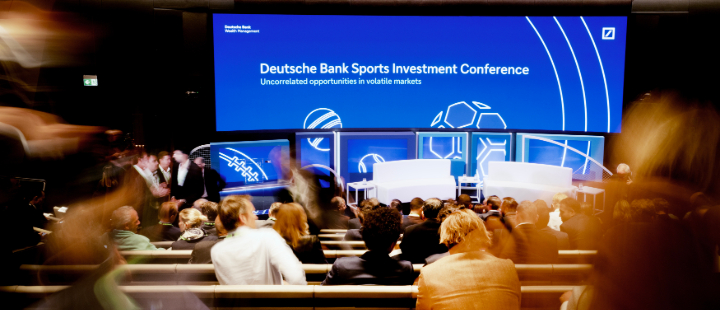
The increasing sophistication of the global sports sector, the rise of women’s sports and the potential for deeper fan engagement to support industry growth were key themes at the inaugural Deutsche Bank Sports Investment Conference, held at our London headquarters in September 2026.
The conference was moderated by Olympic gymnast and seasoned TV presenter Gabby Logan OBE, with a diverse audience including franchise owners, institutional investors, family office representatives, corporate partnership specialists, regulators, accountants and lawyers. On stage, senior Deutsche Bank executives were joined by a variety of experts to explore how the shifting media landscape, increasing crossover with the entertainment industry and diverse sources of global capital are reshaping the business of sport.
To begin the day, Arjun Nagarkatti, Head of US & Europe International at Deutsche Bank's Private Bank, explained that the sports ecosystem has evolved rapidly in recent years and is creating new potential entry points for investors over short, medium- and long-term horizons. He conducted an audience poll that identified two issues viewed as vital to the creation of long-term value: media rights and content commercialisation (cited by 48.1 percent) and maintaining fan trust and engagement (47.5 percent).
Christian Nolting, Global Chief Investment Officer at Deutsche Bank's Private Bank, then gave some context to the event subtitle, “Uncorrelated opportunities in volatile markets”, by drawing on a new special report from his office, Sports Investing: Big league opportunities.1
The factors supporting premium valuations
Annual revenues for the global sports sector could nearly double by 20332, Nolting said, with a “valuation premium” for top-tier teams, underpinned by scarcity, highly engaged audiences and long-duration commercial relationships.
He presented data showing that the investment performance of teams in the large North American leagues, and of leading English Premier League clubs, has had only limited correlation with traditional asset classes and relatively low volatility. This suggests such investments have the potential to support portfolio diversification, he said, though investors should always be cautious when extrapolating historical trends into the future.

Claudio de Sanctis, Member of the Management Board and Head of Private Bank, moderates a panel featuring Avie Glazer, Chairman of Innovate Corp., and Scott D. Malkin, Chairman of Value Retail.

Christian Nolting, Global Chief Investment Officer, Deutsche Bank Private Bank, presents the house view of risks and opportunities in the sports sector.

Derek Chang, President and CEO of Liberty Media Corporation, which owns the media rights to the FIA Formula 1 world championship, shares his insights on the future of motorsport.

Luke Donald, Professional golfer on the PGA TOUR and DP World Tour, former World No.1 and European Ryder Cup Captain, in conversation with Gabby Logan.

Luke Donald and Arjun Nagarkatti, Deutsche Bank's Head of Private Bank for US & Europe International, celebrate the announcement that Deutsche Bank will sponsor the DP World Singapore Open from 2027.
Nolting's closing remark that “the most valuable asset in the world is probably attention and sport owns attention,” set the scene for the following two sessions.
First, Derek Chang, President and CEO of Liberty Media Corporation, the owner of Formula 1, explained how the evolution of the championship into an entertainment asset as well as a sports asset had helped to drive its growth.
Next, panellists including Thomas Riedel, CEO & Founder of Riedel Group, and a pioneer in the entertainment technology industry, took to the stage for “Sport as Strategy: How Corporates Compete Beyond the Field”. They discussed data’s pivotal role in connecting sponsors with sports fans in a world where direct relationships provide first-party consumer data that can support more effective marketing and personalised experiences.
Women’s sport leads the growth stories
The next panel session, “The Fastest-Growing Game: Women's Sport”, saw leading figures from cricket, football and rugby examine one of the sector’s clearest growth trajectories. Panellists highlighted a need for more women’s teams to have their own commercial structures and brand identities, given the different audience base compared with men’s sport.
The potential for commercial growth in women’s sport was raised by many of our speakers throughout the day, with reference to data from various sources. In the United States, for example, revenues from women’s sports grew more than four times faster than men’s sports between 2022 and 2024 and are expected to generate at least 2.5 billion US dollars for rights-holders by 2030.3
Yet successful long-term development in the sports sector will depend on good leadership in the boardroom, as well as on the field. The need for strong governance was emphasised in many of our sessions and especially in “The Business of Winning: How Sports Owners Create Enterprise Value”, hosted by Claudio de Sanctis, Management Board Member and Head of Private Bank, Deutsche Bank Private Bank.
In this wide-ranging and interactive session, our audience got insights from Avie Glazer, Co-Chairman of Manchester United and owner of the NFL’s Tampa Bay Buccaneers, and Scott D. Malkin, Chairman of Value Retail and Co-Owner of the New York Islanders, about how owners balance sporting ambition with financial returns and their role as stewards with a responsibility to fans.
A new forum for the sports ecosystem
Our afternoon sessions included a discussion of how institutional investment in sport is changing, with a panel moderated by James Whittaker, Head of UK Wealth Management at Deutsche Bank Private Bank. “The Long Game: Institutional Capital” covered topics such as direct investing versus funds, how to assess investments in sports teams with negative cash flow and the importance of league structures to risk-return profiles.
Family office investors also shared their views in a panel moderated by Salman Mahdi, Global Vice Chairman of Deutsche Bank Private Bank. “The Private Playbook: Family Office Perspectives” covered everything from investing in niche sports with growth potential to the role of media rights in driving valuations.
We were also proud to announce that Deutsche Bank is the new title partner of the Singapore Open, one of Asia’s most prestigious golf championships, which will form part of the DP World Tour from 2027.
To help celebrate the occasion, we were delighted to be joined by former world number-one golfer Luke Donald, who took to the stage for “The Champion’s Playbook”, a wide-ranging conversation with Gabby Logan. Only the second European captain to win the Ryder Cup home and away, he reflected on his approach to leadership and decision-making under pressure.
In closing the conference, Arjun Nagarkatti spoke of Deutsche Bank’s ambition to create “the Davos of sports”. Thanking delegates for attending the inaugural event, he added: “We want to bring people from across the sporting spectrum together once a year and exchange ideas about a topic we are all passionate about.”

News and insights on sports investing and financing
Event highlights
Deutsche Bank Sports Investment Conference: Why fan engagement is a critical factor in sports value creation
Sep. 21, 2026

Event report and video
Deutsche Bank Sports Investing Conference 2026
Sep. 16, 2026

PERSPECTIVES Special
Sports Investing: Big league opportunities
Sep. 14, 2026

Feature article
When capital meets competition – unlocking potential value in sports investing
Mar. 25, 2026


PERSPECTIVES Special
The global sports industry – Game on: unlocking investor value
Feb. 06, 2026
Show more
Show less
058314 092226