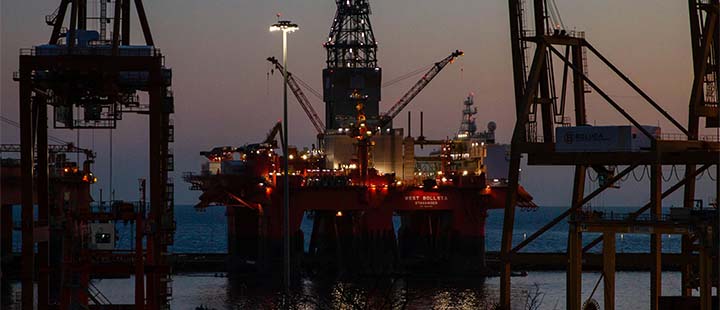
Escalating tensions around the Strait of Hormuz have reignited volatility in global energy markets – posing fresh questions for Europe’s inflation, growth and investment outlook. In this PERSPECTIVES Special we examine how exposed European economies are, how this conflict differs from the 2022 energy crisis, and what this means for markets and policy. We present our latest scenarios and address the implications for investors as Europe navigates increasingly challenging crosswinds.

Key takeaways

  • Recent disruptions to oil and gas shipments through the Strait of Hormuz have contributed to higher energy prices globally and weighed on European economic activity. While diversified supply sources and long-term contracts with suppliers reduce the risk of immediate shortages, a prolonged closure of the Strait could add to inflationary pressure, increasing downside risks to growth and potentially amplifying second-round effects on core inflation and financial markets. 
  • Europe’s macroeconomic resilience is currently being bolstered by fiscal policy, enabling the region to weather some of the energy price spikes triggered by the disruptions to the Strait of Hormuz, with disparities in the exposure and sectoral impacts between Germany, France, Spain, Italy, Sweden, and Norway.
  • European equity market performance is shaped by dispersion, with energy and defensives stabilising while energy‑intensive industries and cyclical sectors remain sensitive to energy price developments and geopolitical risks.
  • Investors must manage a disruption whose effects depend on its length and severity, as well as on the policies from Washington, Tehran, Riyadh, and Brussels.


PDF

Language:

'

In Europe, Middle East and Africa as well as in Asia Pacific this material is considered marketing material, but this is not the case in the U.S.

The value of an investment can fall as well as rise and you might not get back the amount originally invested at any point in time. Your capital may be at risk.

No assurance can be given that any forecast or target can be achieved. Forecasts are based on assumptions, estimates, opinions and hypothetical models which may prove to be incorrect. Past performance is not indicative of future returns. Performance refers to a nominal value based on price gains/losses and does not take into account inflation. Inflation will have a negative impact on the purchasing power of this nominal monetary value. Depending on the current level of inflation, this may lead to a real loss in value, even if the nominal performance of the investment is positive.

This web page is not an offer to buy a security or enter into any transaction. The products, services, information and/or materials contained within these web pages may not be available for residents of certain jurisdictions. Please consider the sales restrictions relating to the products or services in question for further information. Deutsche Bank does not give tax or legal advice; prospective investors should seek advice from their own tax advisers and/or lawyers before entering into any investment.