The Geopolitical Current: the tides shaping maritime trade and power
At the Ocean Summit 2026, experts outlined how geopolitical fragmentation, maritime chokepoints and energy security are elevating the Ocean’s role in global trade, resilience and sustainable transformation.

Long-term structural shifts are reshaping markets and societies. At the same time, the Ocean is becoming increasingly central to economic growth, global security, the energy transition, and long-term resilience.
“We are seeing a rise in ocean-related security incidents, from cable sabotage to other emerging sea-based risks,” said Fabrizio Campelli, Member of the Management Board, President and Head of Corporate Bank and Investment Bank, Deutsche Bank.
“Chokepoints such as the Panama Canal and Strait of Hormuz highlight the Ocean’s influence on global trade. As sea routes are weaponised, the intersection of ocean health and geopolitics has moved beyond a logistical issue and is now a significant economic force, with increasingly disruptive implications,” he added.
The interconnectedness of maritime security, trade resilience and geopolitical risk was a key focus at the summit, where speakers examined how control of critical sea routes, resource competition and energy security are shaping the Ocean’s role in the global economy.
As sea routes are weaponised, the intersection of ocean health and geopolitics has moved beyond a logistical issue and is now a significant economic force, with increasingly disruptive implications
Fabrizio Campelli
Member of the Management Board, President and Head of Corporate Bank and Investment Bank, Deutsche Bank
Bronwen Maddox, Chief Executive of Chatham House, highlighted how globalisation seems to be in retreat. “You really have the sense that old certainties are being redrawn,” she said. “But that doesn’t mean the oceans aren’t still immensely important in connecting everyone in trade.”
Maddox added: “We are moving from a mindset where the oceans were open, and getting increasingly open, to an emphasis on conflict.”
Amid a backdrop of shifting assumptions and a changing global order, ocean conservation remains crucial to everybody on the planet – it connects us all, speakers outlined throughout the day. In an ever more fragmented world.
“New alliances – or ‘coalitions of the willing’ – are being formed wher countries and companies are seeking to reduce risk and uncertainty,” said Maddox.
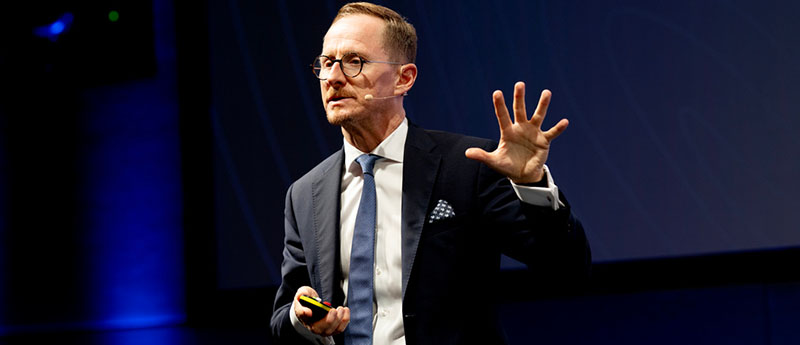
Markus Müller, Chief Investment Officer Sustainability and Global Head of Chief Investment Office, Deutsche Bank Private Bank, noted, explored what a multipolar world could mean for ocean conservation.
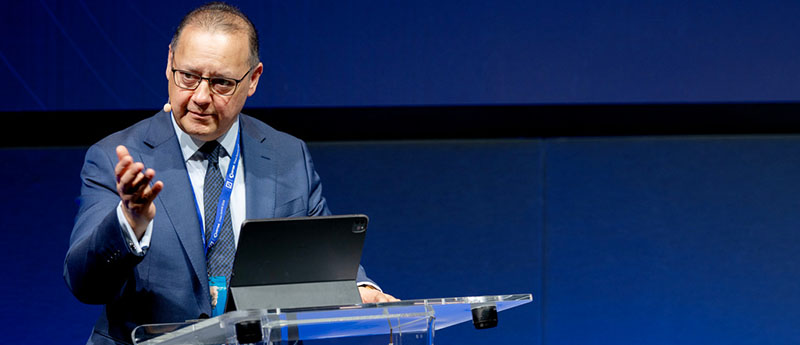
Salman Mahdi, Global Vice Chairman of Deutsche Bank Private Bank, speaks about the importance of collaboration.
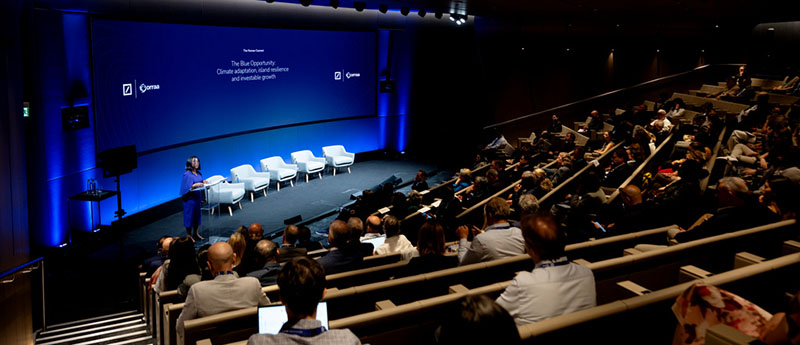
“The only viable route to [ocean] protection is collective action,” urged the Honourable Shirley Botchwey, the Commonwealth General Secretary, at the Ocean Summit.
What geopolitics means for ocean conservation
Lavinia Bauerochse, Head of Sustainable and Transformation Finance, Corporate Bank, and Member of the Corporate Bank Executive Council, Deutsche Bank, described the transition challenge as one shaped by competing pressures: “The path to a sustainable future is no longer straightforward: we have to navigate multiple crosscurrents. On one side, we have a climate imperative. On the other, we face unprecedented geopolitical fragmentation.
“Nevertheless, sustainability and transformation are now fundamental cornerstones for clients, and access to reliable and affordable energy is becoming increasingly critical in the current geopolitical environment.”
Her comments underlined a broader theme of the summit: ocean conservation is connected to industrial competitiveness, energy security, supply-chain resilience, the stability of the global trading system, and geopolitical dynamics.
How capital can support ocean resilience
Campelli highlighted the role banks can play in ocean conservation, stating: “We are at a time when necessity and urgency to move capital at speed has become a priority, but where do we go from here? It’s clients and investors who move capital. Banks are a conduit to finding opportunities, and the Ocean is something that can [potentially] present good business opportunities.”
Collaboration was presented as essential to translating ocean awareness into investable solutions and practical action. Salman Mahdi, Global Vice Chairman of Deutsche Bank Private Bank, said: “Protecting our ocean is one of the most complex challenges. We have no option but to collaborate and build a blue economy together.”
As Markus Müller, Chief Investment Officer Sustainability and Global Head of Chief Investment Office, Deutsche Bank Private Bank, noted, a multipolar world is likely to increase the Ocean’s importance.
He added: “The Ocean provides a powerful lens through which to understand these shifting dynamics, helping us see the environmental pressures we are creating and how we can respond more effectively.”
Why collective action is essential to protect the Ocean
For investors, policymakers, and businesses, the message was clear: ocean resilience is becoming part of a wider conversation about economic stability, transition risk and future growth. Protecting the Ocean requires coordinated action, credible financing structures and a shared understanding that healthy marine systems are fundamental to a more resilient global economy.
“For the ocean – our greatest global system, upon which all life on earth depends – the only viable route to protection is collective action,” urged the Honourable Shirley Botchwey, the Commonwealth General Secretary.
Echoing the call to action that ran throughout the day, she added: “No country can protect the Ocean alone; no bank can finance the transition alone; no market can remain stable on a destabilised planet. To protect the Ocean, we must embrace a deeper task – the renewal of cooperation itself: to prove that partnership can transform; that finance can serve people and planet; that multilateralism can deliver; and that serious institutions can still shape a better future.”

Event report
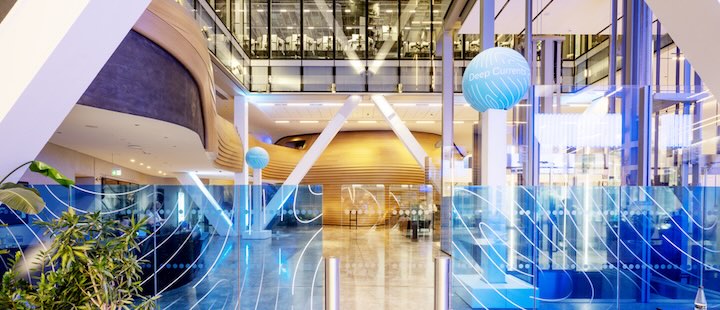
Ocean Summit 2026: deep currents – the forces moving our world
Deutsche Bank and ORRAA convened leaders from finance, policy, science and entrepreneurship in London on June 23 to explore the forces reshaping ocean resilience, blue finance and the blue economy.