The Capital Current: the financial flows enabling ocean resilience and returns
Ocean resilience is emerging as a long-term investment theme. Speakers at the Ocean Summit 2026 explored how finance, blended capital and better data can help scale solutions in the blue economy.

With over 80 percent of the world’s goods transported by sea, maritime routes are essential to global commerce, energy flows, and supply-chain resilience.
“The Ocean sits at the centre of the global economy and is emerging as a key driver of growth, but the world is shifting toward multipolarity – bringing greater volatility and making a functioning ocean system even more critical,” observed Christian Nolting, the Private Bank’s Global Chief Investment Officer, at the 2026 Ocean Summit hosted by Deutsche Bank and Ocean Risk and Resilience Action Alliance (ORRAA).
In relative terms, the blue economy1 has outpaced the global economy since 19952, with ocean exports being of particular importance for Europe and Asia, pointed out Markus Müller, Chief Investment Officer Sustainability & Global Head of Chief Investment Office of the Private Bank. Yet marine-related productivity is now declining as ocean degradation increases.

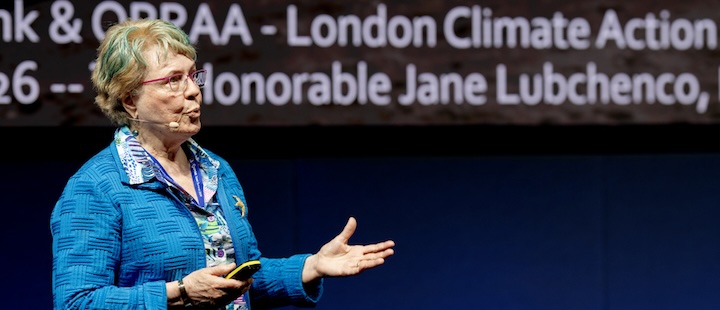
Christian Nolting, the Private Bank's Global Chief Investment Officer, explores Ocean conservation from a macro point-of-view.

His Excellency Surangel S. Whipps Jr., President of the Republic of Palau, argues that ocean health should be understood as core economic infrastructure.

Deutsche Bank’s Chief Sustainability Officer, Jörg Eigendorf, outlines the importance of data for the sustainable blue economy.

Esra Turk, Global Head of Sustainable Finance at Investment Bank, Chair of Investment Bank for Middle East & Africa, in conversation with and Laila Nordine, Senior Manager, Strategic Clients Relationships at International Finance Corporation.

Ruth Davis, OBE, UK Special Representative for Nature, and Markus Müller, share the stage to discuss the importance of the Ocean for the global economy.
“If markets understand the Ocean as a potential investment opportunity, public budgets can be relieved, and capital can flow towards coastline protection and nature recovery,” he said.
Ocean economics: from environmental concern to potential investment opportunity
Lisa Forbes, Chief Strategy Officer and General Counsel of Builders Vision, outlined the sustainable investment opportunities connected to ocean resilience.
“The ocean economy is accelerating, and the transition to a regenerative blue economy is one of the greatest strategic long-term financial opportunities of our generation,” she said.
“The line between environmental impact and market-rate financial returns isn’t just blurring, it’s disappearing. By setting robust standards, adopting clear investment criteria, and driving lending practices that mitigate risk, institutional investors can move this space from a niche category to a mainstream asset allocation,” she proposed.
Throughout the summit, the audience heard how patient capital, blended finance and partnerships can help bridge the gap between early-stage innovation and scalable ocean solutions. The wider message was clear: ocean health is inseparable from the resilience of economies, societies and ecosystems.
Building the conditions for blue finance to scale
Scaling the blue economy is not without its challenges, highlighted Esra Turk, Managing Director, Global Head of Sustainable Finance at Investment Bank, Chair of Investment Bank for Middle East & Africa.
“The capital is there, but a key issue is how finance is structured and allocated. Building a ‘blue’ market requires liquidity, clear frameworks, and a pipeline of scalable opportunities. The goal is to move blue finance3 from niche pilot projects to mainstream investment opportunities,” she stated.
If you are serious about economic resilience, if you care about long-term growth and sustainable value creation, then you have to stop treating the Ocean as a peripheral environmental issue.
His Excellency Surangel S. Whipps Jr.,
President of the Republic of Palau
“Developing high integrity products that also help to converge market standards to enable scaling of capital is one of the aims of the Sustainable Finance team at the Investment Bank of Deutsche Bank,” Turk added. “We have a clear commitment to blue finance, and we are constantly exploring ways to develop labelled instruments to deepen the market for blue bonds while also developing innovative products beyond labels.”
Deutsche Bank’s Chief Sustainability Officer, Jörg Eigendorf, also reflected on the need for scale. “Although there is significant interest in blue finance, without the right incentive structures, it is difficult to mobilise the capital needed. True operationalisation comes down to pricing risk and opportunity, as well as developing sustainable financial instruments that can bring new markets to life,” he stated.
“Data and growing economic interest will shape the future of the Ocean but we still need better metrics to measure impact. Once impact can be measured, it becomes much easier to connect it to financial products and scale investment.”
Entrepreneurs bridging the gap between risk and resilience
Several entrepreneurial success stories of the blue economy were showcased during the day. These included Ørsted’s transformation from fossil fuels to renewable energy, Matter’s technology for capturing microplastics before they enter aquatic ecosystems, ABALOBI’s digital platform supporting small-scale fishers with sustainable fishing practices and market access, DRIFT Energy’s work to produce green hydrogen at sea using high-performance sailing vessels, and Ocean Bottle’s model for funding the collection of ocean-bound plastic through reusable bottle sales.
“These entrepreneurs are working at the beachfront to drive change in mission-driven, often first-of-their-kind initiatives,” said Karen Sack, Executive Director of ORRAA.
“They have to scale the notorious valley of death, where you hit the interface between the end of grant finance and the point where return-seeking capital comes to the table. Our role is to connect the beachfront to the boardroom, and to turn risk to resilience, and resilience to opportunity.”
Echoing a recurring theme of the day, she added: “A healthy ocean is a stabilising force in an uncertain world. If it is destabilised, everything else becomes fragile.”
Valuing nature as economic infrastructure
But there is still a “major gap in how we value the services nature provides to the economy”, according to Ruth Davis, OBE, UK Special Representative for Nature.
“We need to embrace the complexity of the Ocean as a living system – one whose health is fundamental to our own,” she said. “What happens in the Ocean connects us all through geopolitical, security and economic challenges.”
His Excellency Surangel S. Whipps Jr., President of the Republic of Palau, argued that ocean health should be understood as core economic infrastructure.
“If you are serious about economic resilience, if you care about long-term growth and sustainable value creation, then you have to stop treating the Ocean as a peripheral environmental issue,” he said.
“The world can no longer afford climate ambition,” he added. “It has to be climate action.”
References
LSE Global School of Sustainability, Grantham Research Institute on Climate Change and the Environment, “What is blue finance?”, December 2024.
LSE Global School of Sustainability, Grantham Research Institute on Climate Change and the Environment, “What is the blue economy?”, December 2024.

Event report
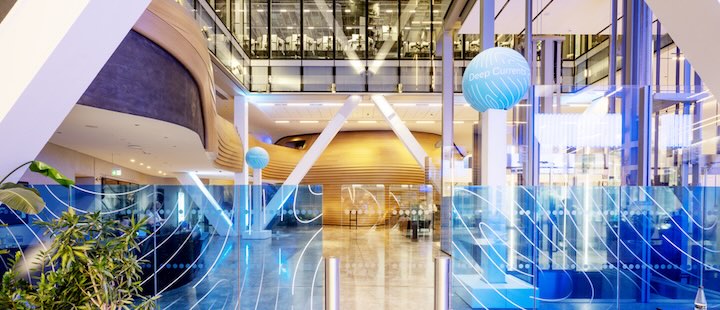
Ocean Summit 2026: deep currents – the forces moving our world
Deutsche Bank and ORRAA convened leaders from finance, policy, science and entrepreneurship in London on June 23 to explore the forces reshaping ocean resilience, blue finance and the blue economy.